

Sapeurs

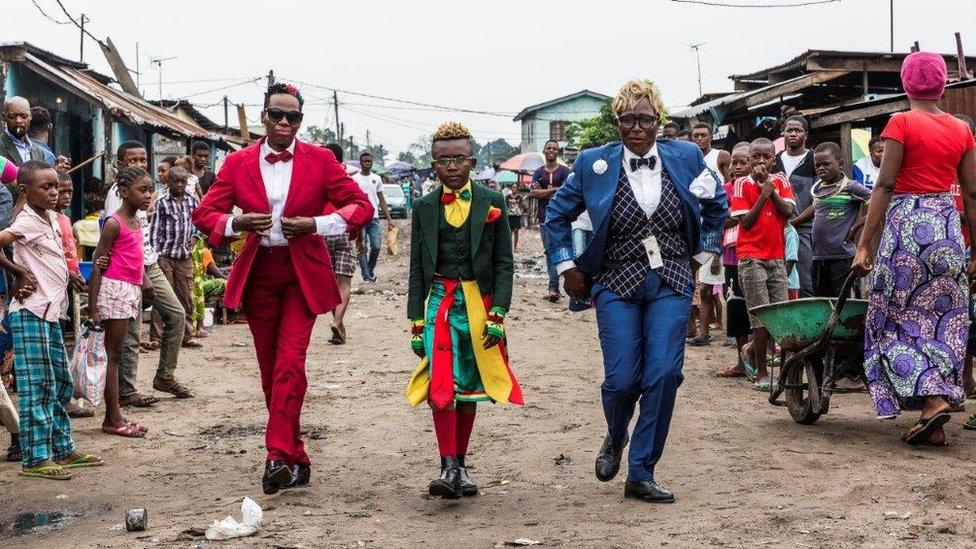
My interest in fashion and style, includes the historical and social aspects of fashion. A part from Mods, Punks, teddy Boys, Rockers and other subcultures, I also find the sapeur subculture really interesting. I have not come across a community of men , women and children who seem to ooze such style, despite their domestic surroundings. There is a stark contrast between extreme well-groomed luxury and the modest, often poverty stricken or war-torn environments in which they live. I am not saying that other subcultures are not able to survive in difficult social settings, indeed, I think the reason a subculture exists, is because as a community they are able to survive. Subcultures arise because they are a type of resistance or way to build community of self-expression, among individuals who feel possibly marginalised or misunderstood by cultural norms.
"Being a Sapeur is about clothes, but it's also about an attitude and a way of being in the world. It's telling the world that no matter what my environmental condition is, I am still human, and I still have dreams and aspirations" Nkodia Aurelie, female sapeuse

Originating in the 1920's, popularised by the muscian, Papa Wemba, Sapeurs transform their lives, wearing and styling themselves with a combination of high-end designer suits and clothing, transforming themselves into icons of style and social pride. La SAPE - Société des Ambianceurs et des Personnes Élégantes, belong to a unique fashion subculture based primarily in Brazzaville, Republic of Congo, and Kinshasa, Democratic Republic of the Congo. Both these neighbouring countries in Central Africa are separated by the Congo River.
According to De Oost Bespoke Tailoring, "La Sape", can be traced back to the period of colonialism, and that, by the end of the 19th century the "houseboys" were the first to embrace European modernity and started to dress to the style of their masters' and made it their own. The article cites the first icon or Grand Sapeur was Andre Matsoua, who was a Congolese anti-colonial activist. After the period of colonialism la SAPE style and social movement was revived by the 1960’s pop star Papa Wemba, also known as the pope of SAPE. Wemba made use of the SAPE’s culture of extravagant dress to challenge the strict dress codes which outlawed European and Western styles, imposed by the government. These strict dress codes were implemented by the government particularly at the tail end of the Rafael Trujillo dictatorship (1961) and during the turbulent 1960's, where there was maintained a conservative social atmosphere. Men were expected to wear long trousers, non revealing clothing, shorts or casual clothing were prohibited. This was mainly outside of tourist areas.
A few thoughts about fashion and colonialism: One could argue that these young men were adopting colonial dress because they were forced, or it was strategic adaptation to the pressure of settler colonisation, rather than voluntarily embracing fashion? On the other hand, perhaps these young men liked what they saw and adapted it, repurposing and selecting European fashion, incorporating their own existing traditions of style. Tariq Zaidi, photographer and author, describes todays "La Sape", style as, "a defiance of circumstance".
Back to Sapeurs..
"La SAPE", became a revolutionary and political movement, which defied political leaders, using appearance as a form of rebellion against the brutal aspects of Congolese life. Today the Sapeurs are well respected and form a positive inspiration in the community, often paid to attend weddings, anniversaries and public events. The SAPE has even moved to European cities like Paris, London and Brussels.
Whilst traditionally La Sape was dominated by men, women sapeuses have become an increasingly common, visible, and influential part of this subculture.

A majority of sapeurs and sapeuses have ordinary jobs, tailors, gardeners and taxi drivers, but after their work, they dress and transform themselves into amazingly, cool, colourful and stylish dandies. They are treated like rock stars as they strut and sashay through the streets. Many will wear designer labels, but sapologie is not about showing one's wealth it is about the ability to put together a look which is unique to their personality. Their style can be eclectic, but it is always cool and often colourful. Their catwalk is the bustling, urban environments, dirt roads and streets of their town/community.

Sapeur families are often treated like local celebrities. These families bringing hope and joy to their local communities who have endured years of conflict. This may appear frivolous where 70% of the population live in poverty, but as Tariq Zaidi explains, it is a defiance of circumstance, a form of social activism.
"My aim was to highlight the important role “La Sape” plays in their defiance of circumstance, through the stark contrast of the elegance of their dress against the harsh backdrop of their surroundings. The Congo is one of the poorest regions of the world and so, at first glance, followers of the “Société des Ambianceurs et des Personnes Élégantes” (the Society of Ambiance-Makers and Elegant People) – La Sape – are an extraordinary sight." Tariq Zaidi, quoted from a CNN post, Friday October 9th, 2020.
If you have an opportunity to look through or buy the beautiful book, Sapeurs: Ladies and Gentlemen of the Congo, by Tariq Zaidi, I recommend you do so. The Youtube video gives you a taste of La Sape way of life and their cool style.
"White people invented the clothes, but we (Africans) make an art of it." Papa Wemba

Fashion, I feel, is not about buying designer labels, but how one styles themselves. Yes, it is great to own a bit of Westwood, but it is all about what you wear it with. I was at the infamous Fat Boy Slim Big Beach Boutique II on Brighton seafront, and I saw a young guy wearing Burberry shorts, a Burberry shirt and a Burberry cap, it did not look cool or stylish. He needed some style advise from a sapeur!
This is not an in-depth academic essay on "La Sape", and I have gathered information from a number of sources, as listed in the bibliography. I hope you enjoyed the read, please like or comment, thank you.
Bibliography
All About Fashion: Les Sapeurs of the Congo
Congo's sapeurs pass their style onto a new generation, BBC, 29 September 2020
The Flamboyant style of the sapeurs, De Oost Bespoke Tailoring, June 10th, 2018
How a world famous Congolese style tradition is taking with the times, CNN, 9th October, 2020
Tariq Zaidi Photography
Big Beach Boutique II, 13th July, 2002.


Comments